- 2:51:01Graduate Commencement Ceremony 2026
- 8:00A Degree Five Decades in the MakingIt’s never too late to finish what you started. Proof of that adage will be on display at this week’s undergraduate Commencement ceremony. That’s when Kerry Lynn will complete an academic journey at Worcester Polytechnic Institute that started in 1972. He’ll walk across the stage to receive his bachelor’s degree 50 years after he first planned. While Lynn entered the university in the Class of 1976, life’s journey made him part of the Class of 2026. “I’ve set graduation goals in the past—graduating alongside my children and so on—but work always intervened,” says Lynn. “Last year, though, I decided it was now or never, and 'never' wasn't an option. I was really determined to finish on the 50th anniversary of my original target.” Since 1972, Lynn’s path has shifted to include a five-decade career and family responsibilities. While juggling it all, he kept chipping away on his WPI degree in computer science. He’d never given up on the goal. “Now that I’m graduating, I hope this accomplishment might inspire even one other person, maybe a fellow student, that there is great value in persistence,” adds Lynn. “I feel persistence is underrated.” 1972–2025 Lynn’s original major was mechanical engineering. He grew up in Connecticut and spent a lot of time around the machine shop his dad, an industrial engineer, had co-founded. In high school, Lynn started to get interested in computers. He was drawn to WPI by its academic program’s focus on project work. “It’s a place where you can chart your own course,” says Lynn. He arrived on campus shortly after faculty approved the WPI Plan in 1970, a bold shift in engineering education that emphasized project-based learning and applying theory to real-world challenges. Lynn left WPI during his second year while still exploring his career path, but his growing interest in computers quickly led him into the emerging tech industry. He worked hands-on with early microcomputers in Connecticut and moved back to Massachusetts in 1982 to resume part-time study at WPI in computer science. As a member of the Boston Computer Society, he attended a 1984 presentation by Apple co-founder Steve Jobs unveiling the Macintosh computer. “That night in Boston was transformative for me,” Lynn says. He and others formed a Macintosh developers’ group on the spot, which Lynn co-led until moving to California in 1987 to join Apple. During his ten years at Apple, he helped develop one of the world’s first wireless local area networks and eventually became an engineering manager in the PowerBooks division. After returning to New England in 2000, Lynn resumed classes at WPI while balancing family life and a career that included roles at Cisco, Verizon Labs, and Oracle. His work contributed to Wi-Fi and internet protocol standards, and he earned 10 patents, including two for wireless network security methods. While in midcareer, he completed a now-discontinued graduation requirement from the original WPI Plan—the competency examination. The requirement culminated in an oral examination conducted by faculty members to determine if a student was well-prepared to enter their chosen profession. Lynn thinks he could be the last person at WPI to graduate under the original version of the WPI Plan, with its competency exam requirement. “During my career, I often didn’t have time to take courses,” says Lynn, who explains the off-and-on approach to completing his required course load. “Graduating has always been at the top of my bucket list, however, so I kept returning to it.” The final academic year In fall 2025, after a layoff accelerated his retirement from full-time work, Lynn decided it was time to make one final push to complete the degree he began decades earlier. While volunteering with Fab Foundation, a nonprofit focused on providing access to and education about digital fabrication tools and technology that supports innovation and creation, he reached out to George Heineman, associate professor of computer science, to explain his goal. “One doesn’t receive such an email every day,” says Heineman, who worked with the registrar and researched old university catalogs with Lynn to determine that he needed to complete a required humanities and arts inquiry seminar (HUA) and a Major Qualifying Project (MQP) to graduate. Heineman became Lynn’s MQP advisor and noted the uniqueness of the project: “As Kerry was writing his MQP report, he found that he had to cite his own work that he did with standards organizations from decades ago. Likely no other undergraduate MQP has had to do the same thing.” For the HUA requirement, Lynn returned to the classroom of David Spanagel, associate professor of humanities and arts, who had taught him years earlier. “While he was in my courses, Kerry enhanced the level of sophistication among our entire classroom learning community because of the philosophical depth of his questions and how authentically he embraced the tasks of understanding our course materials,” says Spana...
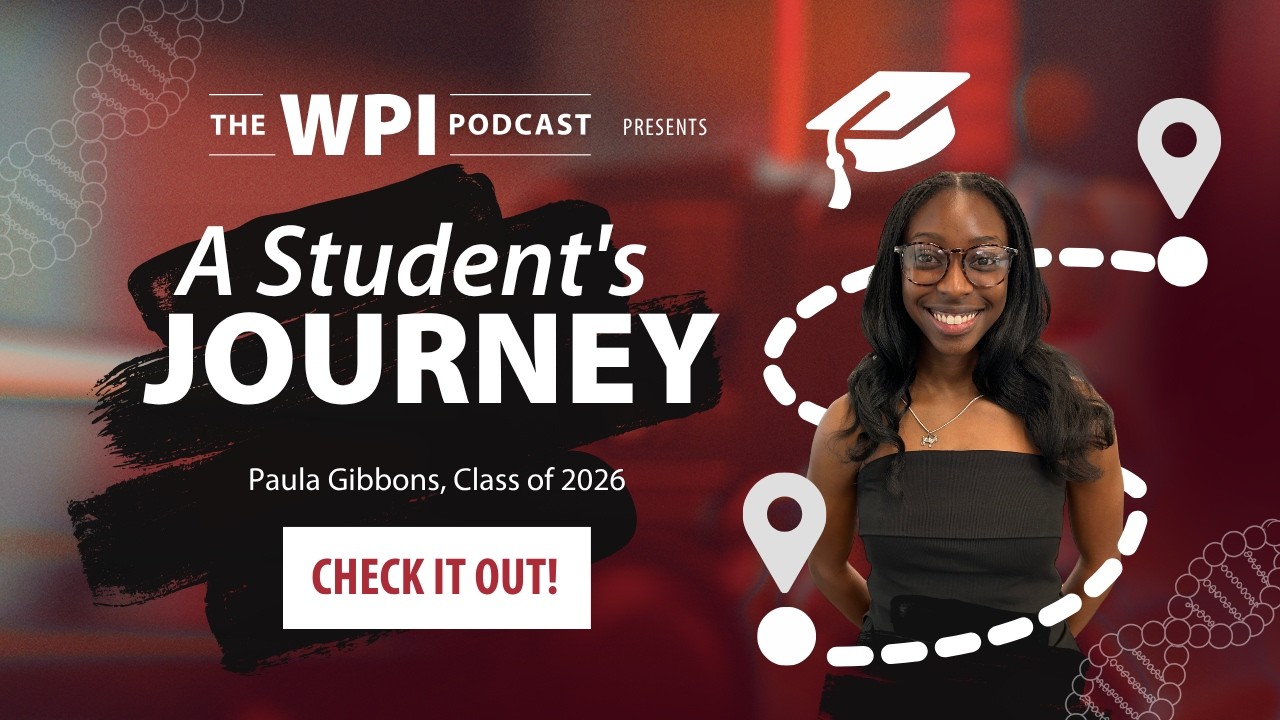
- 27:01E36: A Student’s Journey | Paula Gibbons | Biomedical EngineeringIn this episode of The WPI Podcast, we speak with Paula Gibbons ’26, ahead of her upcoming graduation, about her experiences in classrooms, labs, academic projects, student organization activities, performance spaces, research settings, and more as a student at Worcester Polytechnic Institute. Gibbons, a lifelong Worcester resident who is majoring in biomedical engineering and minoring in biology, shares her motivation for pursuing a career in biomedical research and discusses her plans to continue her education by entering a PhD program at UMass Chan Medical School. Gibbons also discusses her advice for students on selecting a career path and choosing a college or university, as well as what activities and experiences to pursue while in college. Related links: https://www.wpi.edu/academics/departments/biomedical-engineeringhttps://www.wpi.edu/project-based-learning/project-based-education/global-project-program/project-centers/santa-fe-new-mexico-project-center-iqphttps://www.wpi.edu/project-based-learning/project-based-education/interactive-qualifying-projecthttps://www.wpi.edu/project-based-learning/project-based-education/major-qualifying-projecthttps://www.wpi.edu/project-based-learning/lifelong-project-impact
- 5:40Building a Biosensor to Detect Harmful BacteriaResearchers at Worcester Polytechnic Institute have developed a solid polymer coated with harmless viruses to detect the bacteria Salmonella enterica, an advance that could lead to new ways of finding contamination in the food supply. The group, led by Yuxiang “Shawn” Liu, an associate professor in the Department of Mechanical and Materials Engineering, reports that the technology can rapidly capture and visualize foodborne bacterial contaminants in tiny fluid samples. With no need for incubation or complicated equipment in research centers, the technology has the potential to be used as a rapid biosensor in field applications and in areas with few resources. “We have a solid surface that can be used anywhere in the food supply chain, from farm to fridge, to detect foodborne bacteria with minimum human intervention,” Liu says. Foodborne diseases cause millions of illnesses and an estimated 420,000 deaths worldwide annually. Salmonella, a leading cause of foodborne illness, can spread through fecal matter and has been found in raw and undercooked foods, such as eggs, meat, milk, and fresh produce. The bacterium infects the intestines, causing diarrhea, fever, and abdominal cramps. Conventional tests for foodborne bacteria typically involve lab techniques that require special equipment and training. Samples may need to be incubated to allow bacteria to grow so they can be counted, and tests at research centers can take 24 to 48 hours. Other approaches involve amplifying segments of genetic material in samples or detecting antibacterial antibodies in a sample, but those tests may not differentiate live pathogens from dead pathogens. Testing devices with antibodies also tend to have a limited shelf life at room temperature. The WPI researchers went a different route, starting with a flat, textured, and flexible polymer. They attached bacteriophages, which are viruses that develop through natural processes, to the polymer using a chemical process. Bacteriophages can identify and trap specific bacteria that are passing by. The polymer, about the size of a small fingernail, was then placed on the bottom of a channel in a palm-size microfluidic device, and the channel was sealed from the top by a piece of biocompatible plastic tape. The researchers pumped small drops of fluid containing salmonella through the channel, and the bacteriophages concentrated the bacteria on the solid polymer for detection. As a final step, the researchers used a microscope and a light technique called fluorescence imaging to examine the polymers for bright spots where bacteriophages had concentrated the bacteria. Overall, the researchers found that the phage-coated polymers inside a portable device successfully captured salmonella so the bacteria could be seen and assessed at a low concentration level that is still dangerous to human beings but challenging to detect when using existing in-field methods. The research was published in ACS Applied Bio Materials, a peer-reviewed journal of the American Chemical Society. Co-authors with Liu were PhD student Seyed Hamed Ghavami; Teaching Professor Christopher R. Lambert from the Department of Chemistry and Biochemistry; and Jessica Drozd, Class of 2026. The work was supported, in part, with funding from the Gapontsev Family Collaborative Venture Fund. Liu’s research focuses on applications that use light to interact with matter at microscopic and nano scales. Some of his work concentrates on positively impacting the quality and safety of food. In collaboration with other WPI researchers, Liu also has worked on using light to image blood clots with fiber-optic technology and a flexible endoscope that can bend in a patient’s voice box to reach and destroy tiny tumors. Liu says the salmonella detection device outlined in the paper will need more work but could be developed to detect multiple pathogens simultaneously and to detect pathogens in groundwater as well as food. Eventually, the technology might be incorporated into food packaging where it could detect contaminants by coming into direct contact with food. “To translate these findings to practical use, more work is needed on the best ways to prepare samples for testing,” Liu says. “We also want to transition from microscopes to portable readers, such as smartphones, to simplify the process of detecting bacteria. The goal is to create a technology so simple and easy to use that inspectors, retailers, consumers, and others can simply use an app to scan a package and detect pathogens.”
- 0:33Spring at WPIFinal days of classes and it’s giving everything. Almost doesn’t feel real 🌺 ⛲️ 📕
- 16:33Senior Students Showcase Spotlights Real-World Impact and Future-Forward ProjectsWorcester Polytechnic Institute’s annual Undergraduate Research Projects Showcase transformed campus into a vibrant celebration of innovation, discovery, and student achievement as seniors presented the culmination of their academic journeys through Major Qualifying Projects (MQPs). Highlighting the breadth and depth of WPI’s signature project-based education, the event brought together students, faculty, project sponsors, and the broader community to experience how undergraduate research is tackling real-world challenges with the potential to shape industries, improve lives, and change the world. From groundbreaking engineering solutions to interdisciplinary advancements, these capstone projects not only mark a defining milestone for students but often lead to peer-reviewed research, patents, startup ventures, and career-launching opportunities. From sustainable transportation and life-saving robotics to quantum computing and accessible AI, the following projects represent just a sample of the creativity, technical excellence, and real-world impact on display at this year’s showcase. Comparing the Stress Reduction Impact of Social Media Use with Restful Activity Students: Abigail Henry, Casey Dowd, and Eric Zhong Advisors: Stacy Shaw and Louis Roberts The team studied whether deliberate self-chosen restful activities like puzzles or building with LEGOs reduced physiological stress more or less than social media use, which is a common quick coping mechanism students may use for stress relief. The study involved collecting saliva samples and conducting student surveys from 45 student participants. The study found no statistical differences in cortisol level reduction between the strategies tested. The team suggests future research use more study participants and more specific survey questions. Q: What inspired you to take on this project? A: Abigail Henry: “I am super interested in social media. I use it all the time. So, I thought it would be interesting to see how we could juxtapose that with intentional rest to try to help out college students.” Designing Green Infrastructure in Worcester Students: Ethan Paredes and Alison Strojny Advisors: Suzanne LePage and Stephen McCauley The team developed a green infrastructure design plan to mitigate stormwater runoff and the heat island effect in a neighborhood in Worcester. The students suggested a design with natural solutions, including rain gardens and bioswales, to handle runoff around a school. Through mapping data analysis, site visits, and collaboration with project sponsors—the City of Worcester and Weston & Sampson, an engineering and environmental consulting firm—the team proposed solutions to address storms that drop more rain than current infrastructure can handle. Q: How does it feel to know that you’ve got a concrete proposal that could potentially help the City of Worcester? A: Ethan Paredes: “We put a lot of effort into this project. It feels good to see that effort actually materialize into something that is going to make the change that we hoped it would.” Developing a Scanning Device for Integration into Drones for Medical Emergency Rescues Students: Ian Hagglund and Caitlin Murphy Advisors: Guanrui Li and Giovanni Pittiglio The students created a handheld device, which could be carried by a drone, that utilizes two types of cameras and radar to scan a body, measure a person’s vital signs, and detect signs of trauma or bleeding. The goal is to assist first responders in disaster zones by empowering them with technology to locate injured people and assess their physical condition. Q: What motivates you or interests you in this problem?A: Ian Hagglund: “Being able to find a robot to be able to better perceive the world around it and to better perceive people so that it can help people that are in need is really important to me. And it’s also really important to be able to help people at the same time. So that’s really what motivates me.” Analyzing Strategies to Optimize Cloud Gaming User Experience Students: Thomas O’Leary, Jake Lariviere, and Benjamin Perry Advisors: Mark Claypool and Xiaokun Xu The team created a computer game to be played over a network and tested network buffer policies under varying network conditions to study the impact on input delay and smoothness of game imagery. The team identified a no-buffer policy as the best option for this particular game for maintaining a user experience closest to a traditional gaming system in which games are not played over a network. Q: What are you most proud of about this project? A: Thomas O’Leary: “I play a lot of video games. So, being able to make a game was definitely something that I really found enjoyable. And then being able to bring in my computer science knowledge to test all these buffer policies and network delays and the effect they have on the user. It was really interesting working with a team. Th...
- 32:48E35: AI-Generated Content | Rodica Neamtu | Computer ScienceIn this episode of The WPI Podcast, we explore why video, images, and other content generated by artificial intelligence seems to be everywhere on social media. Rodica Neamtu, professor of teaching in the Department of Computer Science, explains how AI-generated content is easily produced and distributed and why it can be difficult to distinguish it from human-generated content. She discusses the societal challenges that emerge when people struggle to determine what’s real versus what’s fake, and she proposes strategies to navigate the fast-moving disruption caused by AI development. Neamtu also shares how she works with WPI students to create AI tools to meet public needs and to consider the potential implications of technology they develop. Related links:https://www.wpi.edu/listen/wpi-podcast/e35-ai-generated-content-rodica-neamtu-computer-science https://www.wpi.edu/about/ai https://www.wpi.edu/academics/departments/computer-science https://www.wpi.edu/project-based-learning/project-based-education/global-project-program/project-centers/bucharest-romania-project-center-iqp https://www.wpi.edu/project-based-learning/lifelong-project-impact https://www.wpi.edu/project-based-learning/project-based-education/major-qualifying-project https://www.wpi.edu/project-based-learning/project-based-education/interactive-qualifying-project
- 5:33Roxanne Armbruster Joins Worcester Polytechnic Institute as Vice President of Talent and Chief Hu...Worcester Polytechnic Institute (WPI) today announced that Roxanne Armbruster, an accomplished human resources and organizational leadership executive with more than 25 years of cross-sector experience, will join the university as vice president of talent and chief human resources officer. Armbruster will report directly to President Grace Wang and serve as a member of the president’s Cabinet. Armbruster brings deep expertise across higher education, technology, and global professional services, with a demonstrated ability to align talent strategy with institutional priorities and drive organizational growth. Her leadership is defined by building scalable, data-informed human resources functions that enable institutions to attract, develop, and retain high-performing teams—capabilities that will support WPI’s continued momentum as a research-driven, innovation-focused university. In this role, Armbruster will lead a team of 19 and will oversee all human resources functions, including talent acquisition, total rewards, leadership development, organizational effectiveness, HR systems and analytics, and inclusive people practices, with a focus on advancing a forward-looking talent strategy that supports WPI’s academic and research enterprise. “WPI’s most critical resource is our people: our talented faculty and our professional staff who are dedicated to education, research, operation, campus life, and the future of WPI,” said Wang. “Roxanne is a leader who brings an exceptional combination of higher education experience, analytical rigor, energy, and commitment to supporting people and community. I am thrilled to have Roxanne join us and lead the critical work of our remarkable Talent and Inclusion team.” Prior to joining WPI, Armbruster served as chief of people and organizational effectiveness at Enterra Solutions, a growth-stage artificial intelligence and data analytics firm. There, she led enterprise-wide human resources and worked closely with executive leadership and the board to align talent strategy, governance, and operations with long-term business objectives, building the infrastructure needed to support rapid organizational growth. She previously served as chief human resources officer and assistant dean at Harvard Law School, where she was a key member of the senior leadership team. She led a comprehensive HR operation supporting more than 600 staff, 800 student workers, and 120 faculty within a complex shared-governance environment. During her tenure at Harvard, she advanced enterprise workforce planning, strengthened compensation and pay equity practices, and modernized HR service delivery—efforts that enhanced organizational effectiveness and positioned the institution for long-term success. Throughout her career, Armbruster has focused on building HR organizations that are strategic partners to leadership—leveraging data, strengthening operations, and aligning HR practices with institutional goals. Earlier in her career, she held senior leadership roles at Ropes & Gray LLP and the TJX Companies, and she began her career on active duty in the U.S. Coast Guard. A longtime member of the Worcester community, Armbruster brings both professional expertise and personal commitment to WPI’s mission and regional impact. She has lived in Central Massachusetts for more than two decades and has closely followed the university’s growth and contributions to the region. “WPI’s mission, culture, and future aspirations strongly align with my own values and leadership approach,” said Armbruster. “I am excited to join the university at an important moment and partner with faculty, staff, and leadership to advance a forward-looking, people-centered talent strategy that supports WPI’s continued growth and impact.” Armbruster holds a master’s degree in corporate and organizational communication from Northeastern University and a bachelor’s degree in leadership. She has also completed advanced professional training in executive coaching, organizational consulting, assessment, and continuous improvement. Armbruster was appointed following a national search and will begin serving in her role May 18, 2026. She succeeds Lauren Turner, who is retiring from WPI after a lengthy and accomplished career in higher education human resources.
- 4:50Uncovering the Path to Heart Valve FailureFor researchers, the path to understanding aortic heart valve disease is littered with clues. Chronic high blood pressure, or hypertension, is a risk factor. So is inflammation. And then there is lipoprotein a, a sticky cholesterol-carrying particle that circulates in the blood. Kristen Billiar, a professor in the Department of Biomedical Engineering, will try to determine what turns those risk factors into disease as part of a $15 million multi-center initiative that is funded by the American Heart Association and focused on early detection and prevention of heart valve disorders. Billiar has been awarded $1,278,213 for a four-year project aimed at determining the connection between circulating liproprotein A, the biomechanical forces at work in the aortic valve, and development of calcific aortic valve disease. It's the most common heart valve disease, causing an estimated 248,256 deaths in the United States in 2019. The disease thickens, calcifies, and narrows the thin, flexible flaps of tissue that open and close in valves as blood moves through a beating heart. Billiar’s project is one of three taking place under the Center for Integrative Valve Science at the University of Pittsburgh. Cynthia St. Hilaire, associate professor of medicine at the University of Pittsburgh, leads the center and will lead a project with collaborators from Creighton University. A third team will be led by Satoshi Okawa, University of Pittsburgh assistant professor of medicine. Together, the three teams will focus on early detection, disease progression, and treatment of aortic stenosis, which is a narrowing of the heart valve that allows oxygen-rich blood to flow out to the body. “The project at WPI will focus on biomechanics, but we will also collaborate with researchers at other institutions who are concentrating on cell biology and using artificial intelligence to examine genetic risk factors” Billiar says. “The goal is to identify targets for potential therapies to treat heart valve disorders.” High levels of lipoprotein A, an inherited condition, seem to play a role in hardening the aortic valve. Yet not all people with high levels of liproprotein A develop valve disease, which suggests that other factors such as inflammation and abnormal mechanics may predispose valves to disease. Billiar will focus on whether disordered blood flow and stretching of valve tissue prime heart valve cells to be sensitive to circulating lipoprotein A and inflammation, leading to calcification. He and researchers in his lab will conduct experiments with valve-on-a-chip technology—human valve cells seeded onto a flexible gel that can be stretched and exposed to disturbed fluid flow. Undergraduate and graduate students at WPI will participate in the research. Undergraduates will have opportunities to work as laboratory assistants and undertake capstone projects, which all WPI students must complete to graduate. Billiar’s research focuses on the field of mechanobiology, which involves understanding how mechanical forces regulate health and disease in connective tissues. He has received funding from the National Institutes of Health to research how stretching and blood flow can inhibit or encourage cardiovascular cells to populate and grow in tissue-engineered heart valves. He has received American Heart Association funding to examine how cell death leads to calcium deposits that cause aortic valves to fail. “This new project builds on years of research and the development of tools that can reveal the role that mechanical forces play in disease,” Billiar said. “Bringing my work together with the work of other researchers has the potential to make great advances in our understanding of heart valve disease and lay the groundwork for new therapeutic approaches.”
- 6:31will.i.am and Alliant Energy CEO Lisa Barton to Speak at Worcester Polytechnic Institute Commence...Worcester Polytechnic Institute (WPI) has announced its speakers for the 2026 Commencement ceremonies: will.i.am, artist, tech founder, and philanthropist, will deliver the undergraduate address, and Lisa Barton, president and CEO of Alliant Energy and a WPI electrical engineering alumna, will speak at the graduate ceremony.The graduate ceremony will be held Thursday, May 14, at 5 p.m., and the undergraduate ceremony will take place Friday, May 15, at 2 p.m., both at the DCU Center in Worcester.“Commencement is a time to celebrate the energy, creativity, and determination that define our graduates,” said Grace Wang, president of Worcester Polytechnic Institute. “will.i.am has energized audiences around the world by blending music, technology, and entrepreneurship in bold new ways, while also expanding access to STEAM and robotics education and opportunities through his forward-thinking philanthropic work. Lisa Barton has spent her career building and operating the infrastructure that powers modern life—from homes and hospitals to the technologies driving today’s digital economy. Together, they represent two powerful forms of innovation that reflect the spirit of WPI.”Undergraduate Commencement SpeakerMultiplatinum, Grammy Award–winning artist, tech founder, and philanthropist will.i.am will address graduates at the undergraduate ceremony. An innovator at the intersection of music, technology, and innovation, he has built a global reputation as a creative force and a leader in advancing artificial intelligence, entrepreneurship, and digital transformation.Beyond his success in music, will.i.am is a committed advocate for expanding access to education and opportunity through the i.am Angel Foundation, which he launched in 2009 to transform lives through education, inspiration, and opportunity—connecting talented individuals with the skills needed to build businesses, pursue meaningful careers, and create lasting impact in their communities. The foundation supports college scholarships, college preparation programs, and hands-on STEAM (science, technology, engineering, arts, and math) and robotics education initiatives.As a creative innovator and futurist, will.i.am also engages youth, educators, policymakers, and the broader tech community to help shape more inclusive pathways into AI and innovation-driven fields. He shares WPI’s commitment to strengthening the pipeline of future innovators through early engagement in robotics and STEM education, equipping students with the critical skills needed for high-impact careers in a rapidly evolving world.Recognized for his outstanding contributions to the international engineering community, will.i.am was named an honorary fellow of the Institution of Engineering and Technology UK in 2017, and in 2025 he was appointed goodwill ambassador for the AI Skills Coalition, led by the United Nations International Telecommunications Union. In 2025, will.i.am was also appointed professor of practice at Arizona State University, where he is currently teaching The Agentic Self, a course he co-developed that explores the relationship between human creativity and artificial intelligence. He also serves on the boards of the USC Iovine and Young Academy, College Track, and FIRST Global. In addition to delivering the undergraduate Commencement address, will.i.am will receive an honorary doctorate in humanities during the undergraduate ceremony.Graduate Commencement SpeakerAs president and CEO, Barton leads Alliant Energy and is positioning the company to power the next era of economic growth—modernizing the grid, expanding generation, and preparing the region as a destination for AI, hyperscale data centers, and advanced industry. Her focus is simple but ambitious: Ensure the energy infrastructure of today can power the technology breakthroughs of tomorrow. An engineer and attorney by training, Barton has spent more than three decades helping transform the energy industry—from grid operations and market design to meeting the energy demands of a rapidly digitizing economy. Before joining Alliant Energy in 2023, Barton served as executive vice president and chief operating officer of American Electric Power, where she led the largest electric transmission network in North America and helped establish the first competitive, investor-owned electric transmission company, Transource Energy, pioneering a new model for infrastructure investment and grid modernization. She currently serves on the boards of the Commercial Metals Company, Edison Electric Institute, American Transmission Company, and the Electric Power Research Institute, helping shape national energy policy and research priorities. Barton will also receive an honorary doctorate in engineering as part of the graduate ceremony. For a full list of 2026 Commencement activities and related information, visit https://www.wpi.edu/news/annual-events/commencement.


Videos

Navigation sectionMessage CenterLocation and PersonaSettings