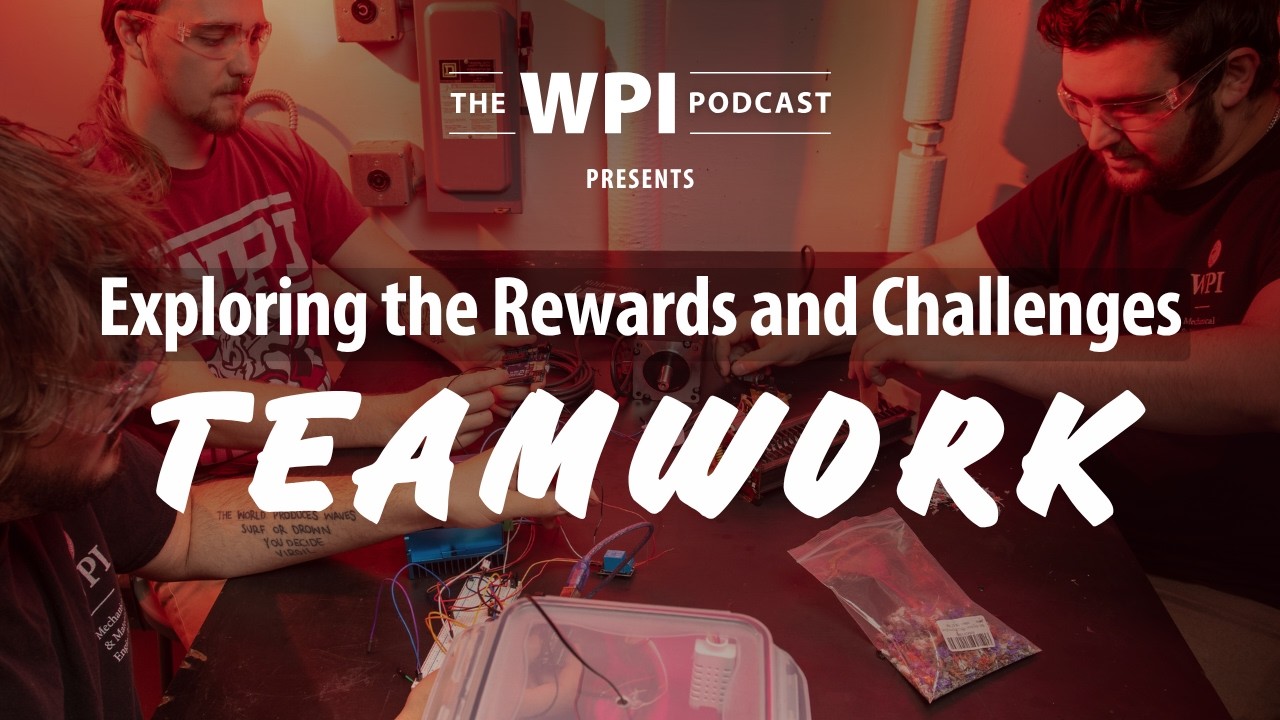
- 35:05E46: Teamwork, Part Two | Lydia Ellen Tonani-Penha | Materials Science and EngineeringIn this episode of The WPI Podcast, we explore asset mapping, a tool teams can use to lay the foundation for more effective and equitable teamwork. Lydia Ellen Tonani-Penha, a PhD candidate in the Department of Mechanical and Materials Engineering and a fellow at WPI’s SWEET Center (Supporting WPI through Effective and Equitable Teamwork), discusses her role at the center, helping to guide students through the common challenges associated with teamwork so they can be stronger teammates and reap the rewards of completing difficult tasks in partnership with others. She describes and breaks down in detail an asset map, via a mock exercise, and explains how any team can use it to plan out roles and responsibilities. This episode will provide listeners with strategies and tools they can consider when embarking on a team project or navigating challenges. This is the second of two episodes on the topic. The first episode, featuring a conversation with Anne Ogilvie, WPI’s director for team learning and the leader of the SWEET Center, can be heard here: https://www.youtube.com/watch?v=MEXMTPPx5_I Related links: SWEET Center https://www.wpi.edu/academics/global-school/departments-programs-offices/sweet-centerProject-Based Learning https://www.wpi.edu/topics/project-based-learning-pblMajor Qualifying Project https://www.wpi.edu/project-based-learning/project-based-education/major-qualifying-projectInteractive Qualifying Project https://www.wpi.edu/project-based-learning/project-based-education/interactive-qualifying-projectAsset mapping template https://www.wpi.edu/sites/default/files/2026-09/Asset-Map-Example-%26-Individual-Fillable-Map.pdf
- 6:26NSF Awards $2 Million to WPI for Student Scholarships and STEM ProgramsThe National Science Foundation has awarded $2 million to Worcester Polytechnic Institute for scholarships and mentoring aimed at improving the retention and graduation rates of low-income undergraduate and graduate students in the fields of robotics, smart infrastructure, and advanced manufacturing. The funding will support scholarships for 70 high-performing students, including transfer students from regional community colleges and the University of Puerto Rico Mayagüez, and contribute to national efforts to increase the size of the U.S. workforce in science, technology, engineering, and mathematics. “It is important to give students from all backgrounds the opportunity to contribute to STEM fields,” said Cagdas Onal, associate professor and head of the Department of Robotics Engineering, who will lead the project as principal investigator. “If we remove the financial constraints that make it difficult for students to devote themselves to learning, those students will be able to graduate at higher rates, succeed in STEM careers, and live as productive citizens.” Onal will collaborate with a team of faculty from across WPI, including three co-PIs: Berk Calli, associate professor of robotic engineering; Gillian Smith, professor in the Department of Computer Science and director of WPI’s Interactive Media and Game Development Program; and Yunus Telliel, director of Great Problems Seminar program and assistant professor in the Department of Humanities and Arts and Interactive Media and Game Development Program. Other faculty members who will be involved are Professor Carrick Eggleston, Associate Professor and Director of Sustainability Paul Mathisen, and Nima Rahbar, the Ralph H. White Family Professor and department head, all of the Department of Civil, Environmental, and Architectural Engineering; Professor Pratap Rao of the Department of Mechanical and Materials Engineering; Professor Sarah Strauss of the Department of Integrative and Global Studies; and robotics engineering Professor Jing Xiao. The team will seek applicants who are studying in four fields: robotics engineering; mechanical and materials engineering; civil, environmental, and architectural engineering; and interactive media and game development. Scholarships will be available for undergraduates who are recipients of Pell Grants, a form of federal financial aid, and graduate students who can demonstrate financial need. “Pell-eligible students have lower retention and graduation rates than other four-year undergraduates,” said Smith. “Scholarships will help lift a financial burden for these students, while supporting them in pursuing exciting, interdisciplinary opportunities in design that open doors for a wide variety of internships and future career pathways.” To recruit transfer students, the team will seek applicants at Quinsigamond, Mount Wachusett, Berkshire, Holyoke, and MassBay community colleges in Massachusetts, as well as Northern Essex and Manchester community colleges in New Hampshire. WPI already has transfer partnership agreements with some of the colleges to ease students’ transfer to WPI. In addition to awarding scholarships, the team will develop and offer students programs that build on WPI’s strength as a leader in project-based learning, including the Great Problems Seminar. Faculty members will mentor students as they complete interdisciplinary projects at different levels. Participants will have access to WPI’s summer educational programs, and the faculty team will partner with companies and nonprofit organizations to provide internship opportunities for students. “All students at WPI must complete research projects focused on real-world problems to graduate, and our programs will enable students to shape those required projects into multiyear, interdisciplinary collaborations that can help pave the way for their future careers,” said Calli. “We place great importance on empowering students to make a positive impact in their communities, and this program will provide many such opportunities, from assistive robotics in healthcare to solutions in waste management.” WPI has previously received funding from NSF for similar initiatives aimed at supporting low-income students and building the STEM workforce. The university was awarded $2.5 million in 2023 for scholarships and programs that are still under way for computer science undergraduates. Earlier initiatives focused on students in renewable energy fields and on undergraduates who were the first in their families to attend college. The new program will examine how a coordinated set of interventions can help talented students from low-income backgrounds succeed at WPI. Telliel said the insights will be especially important in the rapidly changing fields of robotics, smart infrastructure, and advanced manufacturing. “Technological change requires us to broaden our understanding of the capabilities essential to STEM,” Telliel said. “Students who can link technical des...
- 36:16E45: Teamwork, Part One | Anne Ogilvie | SWEET CenterIn this episode of The WPI Podcast, we explore the challenges and rewards of working in teams. Most people find themselves working on a team at some point in their career, and this episode can help everyone be a better teammate and make the most of teamwork. Anne Ogilvie, the director for team learning in The Global School and the leader of the SWEET Center (Supporting WPI through Effective and Equitable Teamwork), shares some tools to help students prepare for team-based project work, which is central to WPI’s educational model. She discusses common difficulties that teams face and how the SWEET Center can work with them. This is the first of two episodes on the topic. The second episode, featuring a conversation with PhD student and SWEET fellow Lydia Ellen Tonani-Penha, can be heard here: https://www.youtube.com/watch?v=ezcIERs-nZM Related links: SWEET Center https://www.wpi.edu/academics/global-school/departments-programs-offices/sweet-centerWPI Plan https://www.wpi.edu/project-based-learning/project-based-education/10-things-to-know-wpi-planMajor Qualifying Project https://www.wpi.edu/academics/undergraduate/major-qualifying-projectInteractive Qualifying Project https://www.wpi.edu/project-based-learning/project-based-education/interactive-qualifying-projectHumanities and Arts Requirement https://www.wpi.edu/project-based-learning/project-based-education/humanities-arts-requirementGreat Problems Seminar https://www.wpi.edu/project-based-learning/project-based-education/great-problems-seminarGlobal Projects Program https://www.wpi.edu/project-based-learning/project-based-education/global-project-programDigital WPI https://digital.wpi.edu/
- 4:04NIH Grant Supports Research into Neuroscience of Sex DifferencesWhy do men and women often respond differently to the same drug, the same stress, or the same brain condition? Worcester Polytechnic Institute (WPI) neuroscientist Jagan Srinivasan has been awarded $554,599 from the National Institutes of Health (NIH) for a three-year project that looks to an unlikely source for answers: a soil-dwelling worm the size of an eyelash. Srinivasan, a professor in the Department of Biology and Biotechnology and director of WPI’s Neuroscience program, will investigate how Caenorhabditis elegans, or C. elegans—a nematode with a nervous system so simple that scientists have mapped every one of its roughly 300 neurons—responds to a pheromone that normally signals mating opportunities. C. elegans has two biological sexes: males and self-fertilizing hermaphrodites. Even with nearly identical brain wiring, however, male and hermaphrodite worms respond differently to the same mating pheromone. Srinivasan’s lab will study how worms learn to avoid this pheromone and how serotonin—the same brain chemical that helps regulate mood in humans—can dial that avoidance behavior up or down depending on sex. “Brain disorders can be difficult to treat,” Srinivasan says. “One challenge is that the activities of our brain are regulated by more than one chemical at a time. Understanding these signals and why sex differences may determine human reactions could help us build the next generation of drugs for human brain disorders.” The project focuses on neuropeptides, small molecules that act as chemical messengers in the brain, and how they enable two versions of essentially the same neural circuit to produce two different behaviors. It’s a question with implications beyond worms. Many human psychiatric and neurological conditions, from depression to anxiety disorders, show sex-based differences in treatment response, and the underlying biology remains poorly understood. The work builds on Srinivasan’s research using C. elegans to study how the nervous system detects, interprets, and transmits olfactory information that influences behavior. He received the WPI Board of Trustees Award for Outstanding Research and Creative Scholarship in 2020, and his work has been published in journals such as Nature Communications. Srinivasan’s project is one of several that are launching in WPI labs thanks to recent NIH awards for research into blood clotting, robotic surgery, proteins, lead poisoning, fibroids, and traumatic brain injury. The NIH funding to Srinivasan comes from a program that specifically aims to make research activities available to undergraduates. “One of the distinctive features of a WPI undergraduate education is the opportunity to get involved in real research,” Srinivasan says. “Students will learn about how to do this research, but they will also learn that research is a process of failing, troubleshooting, and moving forward, which is a way of working that is just as important as doing the experiments.”
- 0:49What's One Thing You Should Know Before the Fall Career Fair?One thing every student should know before walking into the Fall Career Fair — and it's probably not what you'd expect.Catch us at the Fall Career Fair and put these tips to use!
- 6:19WPI Researchers Receive NSF CAREER AwardsWorcester Polytechnic Institute faculty members Fatemeh Ganji and Fanglin Che have been awarded National Science Foundation CAREER Awards for five-year research projects that will lead to breakthroughs in cybersecurity as well as electrochemical technologies guided by artificial intelligence. Ganji, an associate professor in the Department of Electrical and Computer Engineering, will use an award of $624,083 to develop cybersecurity approaches that will protect privacy on AI devices and operate at the edge of networks, such as wearable health monitors. Ganji will focus on vulnerabilities in AI hardware, known as accelerators, that leave devices vulnerable to malicious actors. Che, an associate professor in the Department of Chemical Engineering, was awarded $637,801 to develop a framework that will use AI and data-driven simulation to reveal how small organic molecules known as self-assembled organic ligands influence catalytic reactions during processes that capture carbon dioxide and electrochemically convert it to fuels and other valuable chemicals more efficiently. “CAREER Awards recognize the promise of early-career researchers and provide critical support as they cement their credentials as experts and innovative thinkers in their fields,” said Bogdan Vernescu, WPI vice president and vice provost for research and innovation. “I am delighted to congratulate Fanglin Che and Fatemeh Ganji on this recognition.” The NSF’s Faculty Early Career Development (CAREER) Program offers its prestigious awards to faculty members who have the potential to serve as role models in research and education. The awards also help faculty members build a foundation for a lifetime of educational and research leadership. WPI’s faculty includes more than 40 individuals who have been recognized with CAREER Awards. Ganji’s CAREER project will focus on privacy-preserving neural networks (PPNN), a type of AI that is designed to function on AI chips without revealing sensitive data to unauthorized parties. She will develop approaches to thwart three types of attacks: backdoor attacks that insert malicious functionality into AI chips; side-channel attacks that leverage inevitable information leakage, such as power consumption, to infer private information; and fault-injection attacks that physically alter hardware to extract data. “AI accelerators are in devices everywhere, from home security cameras to hospital treatment rooms,” Ganji said. “Privacy-preserving accelerators on those devices have been considered secure and private, but research at WPI has uncovered potential vulnerabilities that should be explored and addressed so that users can be assured of privacy.” Ganji joined the WPI faculty in 2020. She earned her PhD from the Technical University of Berlin and was a postdoctoral associate at the Telecom Innovation Laboratories/Technical University of Berlin and the University of Florida. Her research focuses on interdisciplinary approaches to machine learning and cryptography for the design and evaluation of security-critical hardware. Che’s CAREER project will focus on developing an AI-enabled, multiscale simulation framework that will help explain how self-assembled organic compounds attached to metals can speed up and improve carbon capture and electrochemical conversion processes. The research will establish predictive design principles linking molecular-scale interactions to catalytic performance and create new AI-enabled tools for accelerating catalyst discovery, reaction optimization, and scientific understanding of complex chemical systems. “The overarching goal of this research is to develop a physics-integrated and interpretable AI framework that can predict how molecular interfaces control carbon capture and conversion reactions,” Che said. “Simulations, when validated by real-world experiments, can help researchers find the materials and processes that will accelerate catalyst discovery and reaction optimization.” Che, who joined the WPI faculty in 2025, focuses her research on using AI to guide the design of energy-saving catalysts and catalytic technologies. She received her PhD at Washington State University and did postdoctoral research at the University of Toronto and the University of Delaware. Both Ganji and Che will integrate new opportunities for student learning into their projects. Ganji will participate in WPI programs aimed at students in grades 9–11, work with undergraduates to perform and publish research, and advise undergraduate teams working on capstone projects that all WPI undergraduates undertake as part of their degrees. Che will develop hands-on demonstrations for K–12 students, launch a new graduate-level course on applied machine learning in engineering, and bring lectures on computational electrocatalysis and machine learning to her YouTube channel.
- 29:31E44: Big Ideas and Bold Beginnings: Building Student Innovators | Ardian Preci | Director of Inno...What happens when a student has a big idea—and what happens when it doesn’t work? Ardian Preci, director of innovation and entrepreneurship programs and I3, the student innovation lab at WPI, discusses how mentors can encourage creativity, offer honest feedback, and guide students through the risks, setbacks, and breakthroughs that are all part of innovation.
- 3:20WPI Awarded $2 Million to Expand Medical Robotics Innovation and TrainingWorcester Polytechnic Institute (WPI) has received $2 million from the Healey-Driscoll administration to expand PracticePoint and create a Medical Innovation and Training Center focused on advancing medical robotics. The award is part of $6.6 million in grants announced through the Massachusetts Technology Collaborative’s RoboBench program. The statewide initiative is designed to give robotics companies and researchers access to the specialized facilities, equipment, and resources needed to test technologies, prepare prototypes for manufacturing, and bring new products to market. WPI will develop the center in partnership with UMass Chan Medical School. It will provide specialized space for developing and testing medical robotics, while creating closer connections among engineers, entrepreneurs, and clinicians. The center will also support hands-on training for nurses and medical residents using robotic technologies. “State support is essential to building the shared research infrastructure that transforms promising ideas into technologies capable of improving lives,” said Andrew Sears, WPI senior vice president of academic affairs and provost. “This investment will draw on the complementary strengths of WPI and UMass Chan Medical School, help address a critical gap in medical robotics commercialization, and strengthen Central Massachusetts’ role in the commonwealth’s innovation economy.” PracticePoint is WPI’s life sciences training and research and development facility, offering clinical spaces and expertise for the design, prototyping, testing, and real-world evaluation of health technologies and surgical innovations. "This funding will enable PracticePoint to evolve into a Medical Innovation and Training Center, providing the unique environments and capabilities needed to develop, evaluate, and demonstrate medical robotic technologies. It will also facilitate clinical adoption of these new technologies, ultimately enabling the transformation of patient care through medical robotics,” said Liaohai Leo Chen, director of PracticePoint. “Just as importantly, the new center will bring innovators into closer collaboration with clinicians and provide nurses and medical residents with hands-on experience using emerging robotic systems. That feedback and training are critical to ensuring new technologies work effectively in real healthcare settings.” Read the Healey-Driscoll administration’s full funding announcement.
- 0:34This is How WPI Does Move-In Day #wpi #MoveInDayHero #collegelifeCan one move-in day turn into a full dance party? Every year, yes. 💃 Move-in day at WPI hits different.
- 0:17Your Welcome Crew, But Make It Magical ✨🐐Meet the WPI move-in squad who geared up with pom poms, Red Bull, megaphones, and all the energy to welcome our new students in. Welcome home, new Goats!


Videos

Navigation sectionMessage CenterLocation and PersonaSettings